celestial mechanics
 Have you remembered to practice the Discipline of Eating today? What about the Discipline of Breathing? Perhaps over the past few days you've mused, "I know that I really should get around to `going to the bathroom', but I'm just so busy..." and you even feel a bit about guilty not having done this.
What's that you say? Hmmm. Why is that?
Right. These "bodily functions" give us very strong messages when these "needs" of ours are not met. (Good thing, too!)
Now, what about other "good" practices in our life, things that bring life to us --- prayer, acts of service, worship, reading edifying material, exercise, meditation? Are we not told that "every word that comes from the mouth of God" is at least as important as "bread"?
Right again. When these "higher" needs are neglected, rather than feeling a strong urge to do them, we feel LESS attraction toward them as they go neglected and as we become distracted by other things.
Being a physicist, I'm inclined to think up mathematical models for things that happen, so let me throw out a couple for ya:
Physical needs could be (roughly) modeled via a spring force (a "harmonic oscillator" if you will). As the distance from equilibrium (i.e. the length of time the need has gone unmet) increases, so does the attraction --- the force --- increase toward restoring the body to equilibrium. (You could even have it be a funny spring with a force that increases faster than linearly.)
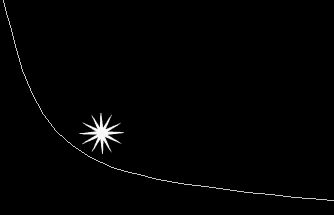
Spiritual needs or "disciplines" might be described better by a gravitational interaction --- still attractive at all finite distances, but decreasing as you go farther and farther out from the Source of the attraction. Like this.
This gravitational model suggests further analogies with "orbits" of people in life, a behavioral kind of "celestial mechanics". Some people orbit very close to the Source, they're tightly "bound" and their energy is "kinetic" --- active and efficacious. Other people orbit further out, and exhibit more "potential" for real work than for actually making a difference ("Apart from Me you can do nothing..."). Some people have circular orbits, other people may have highly elliptical orbits --- moving very close to the source for a short time, then moving away for long times in a periodic succession. There are even people on parabolic or hyberpolic orbits, who have only one interaction with the Source their whole lives, but they will not bind to it and move off alone, increasingly with nothing to orbit but themselves, toward eternal nothingness.
If we include General Relativity, then each of the orbiting bodies is also losing what I'll call "self-energy", losing it in the form of gravitational waves. It's the interaction with the Source that causes this. This loss of self-energy results in orbits which bind tighter and tighter to the Source, until eventually, the orbit is finished and the body finally becomes one with the Source. (For a black hole source, this results in the body passing through the event horizon, never to be seen in the physical world again.)
....We could keep milking these analogies, but I'll stop there. I guess what I'm wondering is, does having some high-fallutin' model like this really help us be more likely to practice meeting our spiritual needs?
...MMMMmmmmmmm...Nah. BUT, knowing they are true needs like the physical ones, should take some of the "compulsion" and "guilt" out of doing or not doing them, respectively.
Actually sometimes I *do* have to remember to eat. Like....now. Cheers.
-Scott
posted by CoreFire at 10:19 PM




4 Comments:
Dear Scott,
Interesting thoughts... Have you left out whole categories of needs that can also be neglected along with physical and spiritual needs, though? If so, what sort of mathematical models would be used to represent relationships with these other needs?
Some personalities are more prone to the tendency of sporatically taking care of physical and spiritual needs than others...perhaps you touched on that with your reference to people exhibiting different mathematical models with their relationships to needs. I'm not condoning that tendency, just stating a noticeable fact. Personalities have different qualities/gifts. Perhaps that's something a person with that sort of personality has to be concerned with compensating for at times, though.
Thanks for your thoughts.
Anonymous, you made a slightly erroneous assessment of Scott's blog. To Scott's credit, he was not saying spiritual and physical needs were the only needs. For one point, consider his following statement:
"Now, what about other "good" practices in our life, things that bring life to us --- prayer, acts of service, worship, reading edifying material, exercise, meditation?"
So there we have kinetic needs, communal needs, and mental needs mentioned. In his statement, he was simply focusing on spiritual needs and leading into this by focusing on the less arguable premise of physical needs. Some would actually consider spiritual needs to have the greatest weight, (even though as Scott pointed out with his models, they don't always have the strongest felt pull).
The perseiving of needs can start to become quite relative and hazy the further removed from physical [bodily function] needs one moves. Someone might perseve the need to see UT play Oklahoma, but uh...that's not really a need but a desire. Some would say that actually spiritual needs would be in this category...arguable as not being in the category of a need. (This is why his stream of logic began with a less arguable point to try to prove the legitimacy of spiritual needs). Perhaps those people who deny spiritual needs never intercept nor come close to the source and as such perceive it as not existing or ignore its existence.
Scott also made a good point--that we should not let guilt be the driving factor in meeting needs. Perhaps, we should let the sheer force of the need drive us to the need? Or perhaps that's not practical? So I ask how then should we make sure our needs are met, if not by guilt or just the compulsion of the need itself?
In answer to tyler's question, I think love should be the driving force in meeting needs--physical, spiritual, or otherwise. I think this philosophy is wisely shown throughout many passages in the Bible.
One verse that pertains is Ephesians 5:2, "And walk in love, as Christ also hath loved us, and hath given himself for us as an offering and a sacrifice to God for a sweet-smelling savor." Jesus saw our need for redemption and met it because of his love. We should do the same day to day in much smaller ways.
Of course, there is also the passage known by many which I think can be extrapolated upon:
"Though I speak with the tongues of men and of angels, and have not charity, I am become as sounding brass, or a tinkling cymbal. And though I have all faith, so that I could remove mountains, and have not charity, I am nothing. And though I bestow all my goods to feed the poor, and though I give my body to be burned, and have not charity, it profiteth me nothing." (I Corinthians 13:1-3).
I think this shows that no matter what you say, do, or how spiritual or gifted you appear, it is worthless if you are not propelled by love. This line of thought can be extended to the meeting of needs. Love should be the motivating factor. Frankly it's not whether the needs appear to be getting met or not, but whether we are compelled by love in our actions.
Another example shows how love helps meet the social needs presented by entering into a marriage agreement. Consider the following verse:
"So men ought to love their wives as their own bodies. He that loveth his wife loveth himself. For no man ever yet hated his own flesh; but nourisheth and cherisheth it, even as the Lord the church..." (Ephesians 5:28-29). I think this shows how if a man loves his wife (I mean with actions not just having feelings), then he will help meet her needs.
This verse also makes me wonder...how many of us "love" our own bodies? How many of us show that we in actuality hate our own bodies by our actions? Do we fail to meet our physical needs? How many of us also purposely do harmful things to our bodies?
But there are many needs before a person. How do we choose which ones to meet? Consider the following passage:
"Now it came to pass, as they went, that he entered into a certain village: and a certain woman named Martha received him into her house. And she had a sister Mary, which also sat at Jesus' feet, and heard his word. But Martha was cumbered about much serving, and came to him, and said, Lord, dost thou not care that my sister hath left me to serve alone? bid her therefore that she help me. And Jesus answered and said unto her, Martha, Martha, thou art careful and troubled about many things: But one thing is needful; and Mary hath chosen that good part, which shall not be taken away from her." (Luke 10:38-42)
There were physical and relational/spiritual needs before the two sisters, and it was said Mary chose the better thing. Hmm...
Exercise is an example of something that is physical and embodied but also a discipline -- you are less attracted to it the less you do it, more attracted to it the more you do it.
Maybe the difference between needs and disciplines is that disciplines do not protect our true ~needs~: perhaps rather they protect our true ~desires~, which we are too weak to act on without help.
Post a Comment
<< Home